
the validation system: an operational manual
on praise avoidance and clinical distance

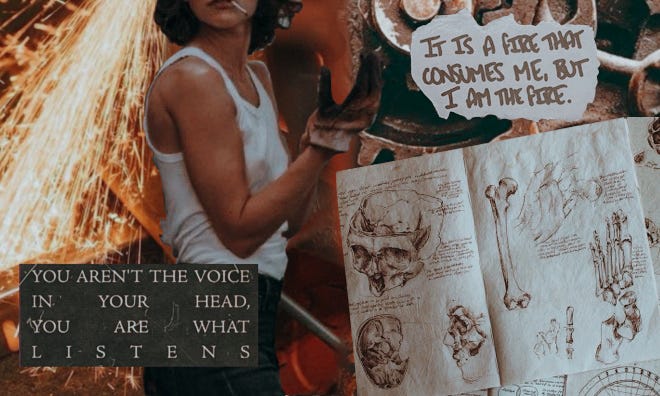
The mechanical whirring wakes with the chime of the first notification. I stare at the shape of the bell, and it stares back.
“Just click the button, Lexis,” I mumble, then close the tab instead. It’s a cat-and-mouse game I play whenever I post my work, the promise of praise dangled at the end of a labyrinth of gears churning.
The comments are always kind, and the kindness is always overridden by the system.
The system operates under a series of code failures.
Praise is a favor that can be revoked at any point.
Being truly seen must be prevented at all costs.
As most people who have been to therapy can attest, you cannot crack open your brain on its hinges and peruse its contents at will. Most issues that land you in a therapist’s office stem from your subconscious mind setting Home Alone-style traps in your life. Snag enough trip wires, and you begin to develop a sixth sense for when your conscious mind is no longer pulling the strings.
Needless to say, I am aware the system is malfunctioning. Well-meaning souls will offer further validation as a fix. But has anyone managed to stop the churning of heavy machinery by yelling into the gears?
I’ve spent a lot of time under the hood over the years. Allow me to slip on my cap and give you a walk-through.

Code 1: Praise is a favor that can be revoked at any point.
The first code is the easiest to diagnose, though it’s probably a trickle-down effect from a larger code failure in the Trust System. I’ve pinged the division about it a couple of times, but they’re swamped as is.
This particular code usually results from close contact with a person whose praise was conditional upon system orientation. When the gears were churning for the benefit of the external entity, praise was given freely and excessively. As soon as the system re-oriented to sustain itself, “I love you”s shouted from rooftops became “I have no respect for you”s hissed in the dark.
I believe the system developed a safety mechanism to prevent praise from causing damage down the line. A threat that should have been isolated to manipulative context has been over-generalized. All praise is signaled as danger.
Let’s move on. That flashing red light is giving me a migraine.

Code 2: Being truly seen must be prevented at all costs.
Full transparency, this code tests my sanity. It’s sneaky, see? It waits until the system softens enough to allow input from outside connections, then goes haywire as soon as the attachments are in place.
But there’s also a predictability to this code that the other doesn’t have. I’ve spent my life decoding the mysteries of the system, but Code 2 knows its intricacies more intimately than I ever could.
It’s been with the system through a childhood in the shadows, forever finding shelter in make-believe. It guided the system through snide comments and empty lunch tables in junior high. It took the system under its wing as adolescent friendships turned into chess matches when all the system wanted was to stop playing a game.
Code 2 is not a failure of the system. It is the system itself.
And I cannot role-play my way out of its consequences anymore.

Creativity and introspection have always been two sides of the same coin in my world. It’s littered throughout my work, story lines that follow eyebrow-raising rises and falls. Ask me for the truth, and I’ll paint a seaside heartbreak so vivid you’ll taste the salt in the air.
Some claim bravery in owning your flaws so deeply you can brand them onto a character. But there’s plausible deniability beneath this type of self-analysis. At the end of the day, even the most honest protagonist is still a lie.
Even in my writing, I seek shelter in clinical distance. I observe my internal landscape from the perspective of an outsider, a mechanic running diagnostics rather than a woman caught in the gears of her own psyche.
And regardless of inclination toward dreaming up narratives, don’t you do the same?
Every time you paint silver linings on storm clouds.
Every time you speak of lessons learned before grief has taken shape.
Every time you turn heartache into a riddle to solve.
You’re slipping on the cap and diagnosing pain as though it’s not yours to hold. But pain is stubborn. It becomes lodged in unexpected places.
Even something as innocent as a flashing notification on a screen.
Thank you endlessly for reading my work. If you enjoyed this essay and want to continue strolling through my corner of the internet, check out these pieces:


A ray of sunshine to take with you: all of your systems are rooting for you.
All my love,

you know lexis, i truly think you are one of the most magical writers on this platform. the way you’re able to formulate your thoughts in an articulative matter is one of the most incredible things that i have the opportunity to be visible to. your writing is a spark of fresh air! it reminds me of carrot cake, in the sense that it is so so so so so magnificently whimsical, such a beautiful scent. both carrot cake and your writing are so easy and elegant to devour on a daily basis. i know i’ve slipped behind on your work a bit - i have a bit of catching up to do. and i think this was an extremely good place to start. i can’t get enough of your writing, lexigeous!!!
love this. i think about this often when i think about how much easier it is for me to write emotion through analysis vs being fully open